


0086-18218346058 info@qiruisafe.com
0086-18218346058 info@qiruisafe.com
It is a passive vehicle barrier system installed flush with the road surface. When activated, it rapidly raises a series of sharp, hardened steel spikes or blades angled in one direction. Its primary purpose is to puncture and deflate the tires of a vehicle attempting to breach a secured perimeter, stopping it effectively by causing irreversible, rapid air loss.
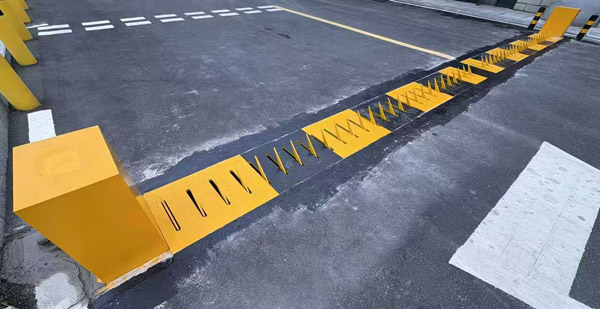
It's a more aggressive and definitive deterrent compared to bollards or barriers that aim to lift or block.
Spike Strip System
Denial Barrier
Tire Deflation Device
Road Spike System
Resting State: The unit is level with the road, allowing authorized vehicles to pass over it freely.
Activation: Upon a security threat (manual, remote, or automated signal from a guard, loop detector, or access control system), an electric or hydraulic mechanism is triggered.
Deployment: The steel spikes/teeth rotate upward to a fixed angle (usually 45-60 degrees) in milliseconds. The spikes are unidirectional—they lay flat when driven over in the authorized direction but lock rigid to puncture tires coming from the opposite, unauthorized direction.
Effect: When a vehicle's tires roll onto the raised spikes, they are deeply punctured. The angled design often causes the spike to tear the tire upon exit, leading to catastrophic deflation within seconds, not just a slow leak. This prevents the vehicle from continuing at speed or for any significant distance.
Military & Government Installations: Protecting entrances to bases, embassies, and sensitive government buildings.
Critical Infrastructure: Power plants, water treatment facilities, data centers, communication hubs.
High-Security Commercial Sites: Corporate headquarters, R&D facilities, high-value warehouses.
Prisons & Detention Centers: Preventing vehicle-assisted escapes or attacks.
Airports: Securing perimeter entrances to airsides and restricted areas.
VIP Protection: Used at checkpoints for events or secure residences.
Highly Effective Deterrent: The threat of total tire destruction is a strong psychological and physical deterrent.
Definitive Stop: Doesn't just block; it ensures the vehicle cannot be driven away after an attempt.
Passive & Unobtrusive: When retracted, it doesn't impede normal traffic or aesthetics.
Directional Control: Allows free exit while preventing unauthorized entry (or vice versa).
Works with Various Speeds: Effective against both high-speed ramming attempts and slow, forceful intrusions.
Lethal Force Consideration: In many jurisdictions, deploying a device that could cause a vehicle to crash (especially at high speed) is considered a use of lethal force. Its use must be justified under strict rules of engagement and local law.
Liability: If deployed incorrectly (e.g., against an authorized vehicle or causing a crash that injures bystanders), the liability is enormous.
Controlled Environment Required: Must be used in a fully secured, controlled approach where no innocent drivers or pedestrians can accidentally encounter it. Clear warning signs are often legally required.
Maintenance: Requires regular maintenance (especially hydraulic systems) to ensure reliable deployment and to prevent corrosion from road salt and debris.
Cost: High initial purchase and installation cost, plus ongoing maintenance.
Not a Standalone Solution: Always part of a layered security approach (e.g., used behind a primary gate, with guards, cameras, and bollards).
Fixed vs. Removable: Most are permanently installed, but portable, rapid-deployment versions exist for tactical use.
Mechanism: Electric, hydraulic, or manual (crank) operation.
Spike Design: Various tooth shapes and materials for different tire types (including run-flats, to some degree).
Control Integration: Can be integrated with license plate readers, RFID card systems, and panic buttons.