


0086-18218346058 info@qiruisafe.com
0086-18218346058 info@qiruisafe.com
Swing barrier turnstiles (also known as optical turnstiles, flap barriers, or tripod turnstiles) are a very common and effective security and access control solution in airports worldwide.
Access Control & Security: They create a controlled, one-way flow of passengers, separating secure areas from public ones. The most critical use is at the entrance to secure departure gates after security checkpoints. Only passengers with valid boarding passes can pass through.
Ticket/Boarding Pass Validation: They are integrated with readers (barcode scanners, QR code readers, NFC for mobile boarding passes, or biometric systems) to automatically validate credentials before allowing passage.
Crowd Management: They organize passenger flow into orderly queues, preventing bottlenecks and chaotic rushes at gate entries.
Paid Access Areas: They can control entry to premium lounges (e.g., business class lounges) or other restricted zones within the terminal.
Employee Access: Used in staff-only areas (baggage handling, operations centers, tarmac access) to ensure only authorized personnel can enter, often using RFID cards or biometrics.
High Throughput: Allow a relatively fast flow of people (typically 20-30 people per minute per lane), which is crucial for managing large numbers of passengers during peak boarding times.
Deterrence of Tailgating: The physical swinging barriers (usually glass or acrylic flaps) make it difficult for a person to follow closely behind an authorized user without their own valid credential. Advanced models have anti-tailgating sensors that detect multiple people in a single lane and lock.
Directional Control: Enforce one-way traffic, which is essential for the logical and secure flow of passengers.
Aesthetic & Modern Look: Their sleek, glass-panel design fits well with modern airport architecture, providing a secure yet open and welcoming feel—less imposing than full-height turnstiles or gates.
Integration Capability: They easily integrate with the airport's overall security and passenger management systems (PMS), flight information systems, and databases.
Durability: Built to withstand 24/7, high-traffic usage.
ADA Compliance: Banks of turnstiles always include at least one wider lane or a dedicated accessible gate (often a swing gate operated by staff or a wide-aisle flap barrier) to accommodate wheelchairs, luggage carts, and passengers with reduced mobility.
Gate Entry Points: After the waiting area, just before entering the jet bridge.
Security Exit Points: To ensure no one re-enters the secure side from the arrivals/baggage claim area.
International Passport Control: Sometimes used to manage lines at automated passport control kiosks (ePACs).
Premium Lounges: At the reception area of airline lounges.
Baggage Claim Entrances: In some airports, to ensure only arriving passengers access the baggage carousel area.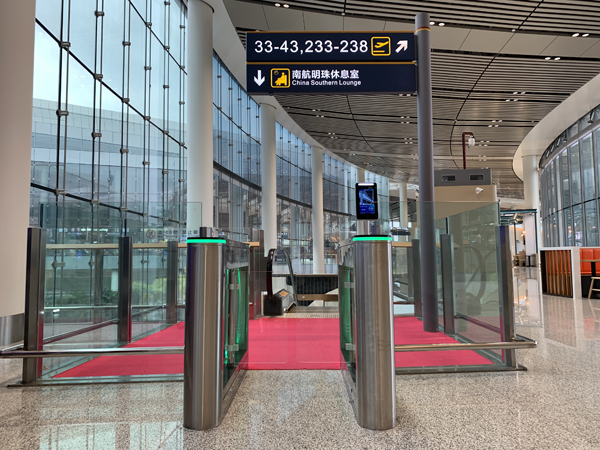
Modern airports are moving towards seamless and contactless journeys. Swing barriers are now increasingly integrated with:
Biometric Systems: Using facial recognition as the credential. A passenger looks at a camera, the system matches them to their flight, and the barrier unlocks—eliminating the need to scan a physical boarding pass.
Mobile & Wearable Tech: Integration with Bluetooth or NFC from smartphones or smartwatches.